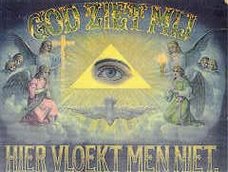
On July 1 1961 my beloved grandfather Franciscus Joannes Neukermans passed into eternal life in the OLV clinic in Aalst after weeks of excruciating pain and deep suffering. One day he made a bad fall in his house and a neighbour found him : we then found out that he had a very bad - until then undiagnosed - brain condition.
We had no car at that time so my father and mother and my brother (grandfather's godson) drove to the clinic in the car of a family friend. There was no place for me in the VW. When they arrived grandfather asked where I was (I was his oldest grandson and I spent most of my holidays with him). I arrived by train but couldn't see him until the next day. He did not recognize me any more - he never again recognized me. Even now, 46 years later, that is a very sad memory.
Grandfather was a carpenter with the Belgian railroads for most of his life (many men in his family worked for the railroads, including two of his sons) and was also a very active member of the christian labor union. Like most working people at that time he had a big vegetable and fruit garden and a couple of fields for wheat, potatoes and other staple food, as wel as some livestock (chickens, goat, pig ...).
He was widowed a couple of years before his retirement and survived grandmother by almost 12 years. He had one of the first TV sets in the village and so every night the neighbours gathered around his set to watch that technological miracle.
After he retired, he made a point of visiting us regularly in Ghent, always for a day, and almost every time he made a point of visiting the shrine of Our Lady of Lourdes in Oostakker.
Bloed kruipt waar het niet gaan kan zeker ?

30 juni
Het is pas nieuwjaar geweest en het nieuwe jaar is weeral half voorbij - en zeggen dat tijd ons kostbaarste bezit is, en toch ook iets dat we nooit bezitten. Eigenlijk bezit de tijd ons en doet maar wat. En de man met de zeis komt alsmaar dichterbij. Daarom "Carpe Diem" ! Met de combinatie van de nog beschikbare tijd en onze grote of kleine talenten kunnen wij er misschien toch nog iets van bakken, voor onszelf of voor de anderen.
Time is money ? Tijd is geld ? Nee, tijd is leven - de tijd gaat snel, gebruikt hem wel !
Time is money ? Tijd is geld ? Nee, tijd is leven - de tijd gaat snel, gebruikt hem wel !
Names and surnames
I have been named after two uncles, one on my mother's side (Paul) and one on my father's side (Etienne), who both died young.
Up to the second World War and even afterwards, family names were almost never used.
I thus am Paul van Margriet van Cis van de Kloefkapper, or : Paul van Margriet van Marie van Schouppens ; and also Paul van Petrus van Pieje uit 't Schalkom ; and (probably) Paul van Petrus van Margriet van Champetters.
I remember that my mother used other names still, but I have forgotten those ... I think one was : Paul van Margriet van Marie van Fernantes.
Up to the second World War and even afterwards, family names were almost never used.
I thus am Paul van Margriet van Cis van de Kloefkapper, or : Paul van Margriet van Marie van Schouppens ; and also Paul van Petrus van Pieje uit 't Schalkom ; and (probably) Paul van Petrus van Margriet van Champetters.
I remember that my mother used other names still, but I have forgotten those ... I think one was : Paul van Margriet van Marie van Fernantes.
My maternal grandparents

.
An even worse photo of my maternal grandparents and their children, but the only picture I have. The photo must have been made before 1934.
Top row : my grandmother, Paul, my grandfather, my mother ; second row : Kamiel and Jef ; sitting : Eugeen.
Joannes Franciscus Neukermans (Okegem December 24 1886 - Aalst July 1 1961) married Maria Antonia De Vidts (Pamel January 31 1885 - Okegem September 25 1949).
They had the following children :
* Kamiel (Okegem 1913 - Okegem 1936). More about him in a later article ;
* Margaretha Felicitas (Okegem 1914 - Ghent 2000) ;
* Jozef (Okegem 1916 - Liedekerke 1994) ;
* Paul Joannes (Okegem 1920 - Okegem 1934) ;
* Eugeen Robert (Okegem 1921 - Okegem 2004).
Cis and Marie had seven grandchildren of whom I am the oldest.
My paternal grandparents
 .
.This is the best picture I have of my paternal grandparents and their surviving children, made on July 22 1939, the day my parents got married.
From left to right : Jef, my grandfather, Godelieve, my grandmother, Antoine, my father, Gabrielle.
Pieter Jozef Timmermans (Meerbeke August 18 1886 - Ninove December 4 1953) married Rosalia Margaretha Ravijst (Meerbeke March 20 1892 - Ghent December 2 1973).
They had the following children :
* Gabriella (Meerbeke 1912 - Meerbeke 1992) ;
* Petrus Joannes (Meerbeke 1913 - Gent 1980) ;
* Jozef (Meerbeke 1915 - Namur after 1994) ;
* Lodewijk Jozef Albert (Meerbeke 1916 - Meerbeke 1918) ;
* Godelieve (Meerbeke 1925 - Gent 1997) ;
* Antoine (Meerbeke 1928 - Ninove 1994) ;
* Etienne Theodore (Meerbeke 1939 : he died a couple of days after birth - the photo thus was made approximately 6 months after his death).
Pieter and Margaretha had12 grandchildren, of which I am the oldest.
Fortress Europe
It is reported that since 1993 at least 8.000 migrants and fugitives died trying to enter "Fortress Europe". About three people every two days pay the highest price in their quest for freedom and well being. And these numbers are incomplete by definition.
All of us are at least partly responsible for these deaths : we have a moral duty to help those who flee hunger, war, extreme poverty and persecution by taking them in and by making pariahs out of the robber governments responsible for the criminal behaviour which creates these problems in the first place.
All of us are at least partly responsible for these deaths : we have a moral duty to help those who flee hunger, war, extreme poverty and persecution by taking them in and by making pariahs out of the robber governments responsible for the criminal behaviour which creates these problems in the first place.
The Achilles heel of multiculturalism
All generalisations are dangerous. But sometimes they help to clarify or to develop arguments. What follows is an almost verbatim quote from a conservative internet blog. Food for thought I would say : it is a fact we have allowed or even favored ghetto development in our cities instead of pushing actively for integration with respect for diversity : and we will be partly responsible at least for the dire effects these ghetto politics may bring. And maybe the following article overestimates the importance of Islamist extremism in Europe.
"Multiculturalism grew up in a time where people, unhappy with the behaviors of their forefathers, sought to find alternative role models in the cultures of other parts of the world, and used them, somewhat like a smorgasbord, to pick and choose things they would like to be part of their world view. It goes hand in hand with the repudiation of the older cultural norms and the longing to make something that seemed more fair, clean and perhaps holy in the eyes of the beholder. But an end result was something that could be easily exploited by those who had other agendas besides the merging of all that was good in a culture into a matrix that everybody would enjoy.
Besides the destruction of the "old truths and verities" as William Faulkner used to say, contemplate this : resistance to integration and assimilation into the mainstream culture is the cornerstone of the Islamist extremist agenda as it helps in the development of closed societies within the host societies.
There is no doubt that a community that allows a number of closed communities to develop in its midst loses its social cohesiveness and becomes dysfunctional. It becomes a source of discontent and dissatisfaction, breeds conflicts and lives in a perpetual state of tension. Knowing that a marginalised and disenfranchised youth serves as a never-exhausting source for terrorism and a divided society breeds such young men, the Islamist extremist establishment has worked diligently to sabotage social harmony in Europe.
As a first step toward achieving this objective, Muslim extremists are convinced that they will have to insist on maintaining their “Islamic” identity, as their culture is better than the host culture. To further divide the host societies along the religious lines, Muslim extremists are encouraged to refuse to evolve in the culture in which they live. They are being forced to recede into closed societies by refusing to integrate into the mainstream culture.
At best, this "celebration of diversity" has brought cultural weakness and social disruption everywhere where its brand of intolerant "toleration" has become the norm, destroying the old fall back positions that gave people under pressure a way to bond together in strength until the danger has passed. And now, it is playing into the hands of those who wish to bring the entire edifice of Western civilization down.
Is it too late to stem the tide? (1) "
No, it is not ! Mutual respect will do the trick ! But a tall order that is !
(1) slightly adapted from : http://voicesfromthelongwar.blogspot.com/ : quoting this blog does not imply that I agree with its whole contents.
"Multiculturalism grew up in a time where people, unhappy with the behaviors of their forefathers, sought to find alternative role models in the cultures of other parts of the world, and used them, somewhat like a smorgasbord, to pick and choose things they would like to be part of their world view. It goes hand in hand with the repudiation of the older cultural norms and the longing to make something that seemed more fair, clean and perhaps holy in the eyes of the beholder. But an end result was something that could be easily exploited by those who had other agendas besides the merging of all that was good in a culture into a matrix that everybody would enjoy.
Besides the destruction of the "old truths and verities" as William Faulkner used to say, contemplate this : resistance to integration and assimilation into the mainstream culture is the cornerstone of the Islamist extremist agenda as it helps in the development of closed societies within the host societies.
There is no doubt that a community that allows a number of closed communities to develop in its midst loses its social cohesiveness and becomes dysfunctional. It becomes a source of discontent and dissatisfaction, breeds conflicts and lives in a perpetual state of tension. Knowing that a marginalised and disenfranchised youth serves as a never-exhausting source for terrorism and a divided society breeds such young men, the Islamist extremist establishment has worked diligently to sabotage social harmony in Europe.
As a first step toward achieving this objective, Muslim extremists are convinced that they will have to insist on maintaining their “Islamic” identity, as their culture is better than the host culture. To further divide the host societies along the religious lines, Muslim extremists are encouraged to refuse to evolve in the culture in which they live. They are being forced to recede into closed societies by refusing to integrate into the mainstream culture.
At best, this "celebration of diversity" has brought cultural weakness and social disruption everywhere where its brand of intolerant "toleration" has become the norm, destroying the old fall back positions that gave people under pressure a way to bond together in strength until the danger has passed. And now, it is playing into the hands of those who wish to bring the entire edifice of Western civilization down.
Is it too late to stem the tide? (1) "
No, it is not ! Mutual respect will do the trick ! But a tall order that is !
(1) slightly adapted from : http://voicesfromthelongwar.blogspot.com/ : quoting this blog does not imply that I agree with its whole contents.
De Dikke van Pamel
From my earliest days on I heard stories about the "Fat Man" of Pamel. He still is part of regional legends and folk lore.
Victor De Clerck was born at Pamel on June 14 1848 and died there on February 16 1885. That was a fortnight after my maternal grandmother Maria Antonia De Vidts (Pamel, January 31 1885 - Okegem September 1949) was born. Her parents, Felix De Vidts (Pamel, April 12 1853 - Pamel, June 8 1940) and Blondine Muylaert (Denderhoutem, June 4 1849 - Pamel February 10 1942), were close neighbours of Victor. Felix was a distant relative (see further).
Victor's exact weight is unknown but is reported to have been up to 300 - 350 kg. Even during his lifetime he was famous and much sought after as a curiosity. As a result he became progressively an unsociable and withdrawn, probably even embittered, individual. His life - at least the later part of it - must have been hell.
Folk lore has it that on hot days he floated on the Dender river, and that children used him as a small island to sit on. He was so big that the front door had to be broken out in order to get the huge casket out of his house.
Victor's paternal grandmother was Barbara Constantia Van der Sleyen (Pamel, March 25 1772 - Pamel, July 29 1847). Her grandparents were Jasper Van der Sleyen (Pamel, June 24 1686 - Pamel, July 2 1749) and Catharina Huylenbroeck (Pamel, ca 1685 - Pamel, March 7 1751).
Jasper and Catharina are my common ancestors with Victor. I descend from them, both through my mother (7th generation) and through my father (8th generation).
More information : "De Dikke Van Pamel, zijn leven, zijn tijd, zijn buurt" by Gerard Van Herreweghen, Davidsfonds Roosdaal, 1985.
Victor De Clerck was born at Pamel on June 14 1848 and died there on February 16 1885. That was a fortnight after my maternal grandmother Maria Antonia De Vidts (Pamel, January 31 1885 - Okegem September 1949) was born. Her parents, Felix De Vidts (Pamel, April 12 1853 - Pamel, June 8 1940) and Blondine Muylaert (Denderhoutem, June 4 1849 - Pamel February 10 1942), were close neighbours of Victor. Felix was a distant relative (see further).
Victor's exact weight is unknown but is reported to have been up to 300 - 350 kg. Even during his lifetime he was famous and much sought after as a curiosity. As a result he became progressively an unsociable and withdrawn, probably even embittered, individual. His life - at least the later part of it - must have been hell.
Folk lore has it that on hot days he floated on the Dender river, and that children used him as a small island to sit on. He was so big that the front door had to be broken out in order to get the huge casket out of his house.
Victor's paternal grandmother was Barbara Constantia Van der Sleyen (Pamel, March 25 1772 - Pamel, July 29 1847). Her grandparents were Jasper Van der Sleyen (Pamel, June 24 1686 - Pamel, July 2 1749) and Catharina Huylenbroeck (Pamel, ca 1685 - Pamel, March 7 1751).
Jasper and Catharina are my common ancestors with Victor. I descend from them, both through my mother (7th generation) and through my father (8th generation).
More information : "De Dikke Van Pamel, zijn leven, zijn tijd, zijn buurt" by Gerard Van Herreweghen, Davidsfonds Roosdaal, 1985.
Zonder scrupules ...
... de straat op. Een belangwekkend artikel over de rol van godsdienst in onze cultuur. Het is gebaseerd op een boek van Herman De Dijn waarin hij zich voorstander toont van een gezonde aanwezigheid van religie in de publieke ruimte - in tegenstelling tot de zeer gangbare mening dat de kerken zich moeten terugplooien op, of zelfs opsluiten in, "een kleine kudde gelijkgezinden en uitverkorenen".
"De oplossing ligt misschien helemaal niet in het doorgaan op de weg van de aanpassing aan moderniteit ('bevrijding') of postmoderniteit ('individuele spiritualiteit'). Ze zou wel eens kunnen liggen in 'finding the old way forward', in een herontdekking van de eigen traditie en in de implementatie daarvan in het reële, alledaagse leven."
Voor de volledige tekst : http://www.tertio.be/archief/2007/T381/T381-spi2.htm.
An interesting article about the role of religion in public life.
"De oplossing ligt misschien helemaal niet in het doorgaan op de weg van de aanpassing aan moderniteit ('bevrijding') of postmoderniteit ('individuele spiritualiteit'). Ze zou wel eens kunnen liggen in 'finding the old way forward', in een herontdekking van de eigen traditie en in de implementatie daarvan in het reële, alledaagse leven."
Voor de volledige tekst : http://www.tertio.be/archief/2007/T381/T381-spi2.htm.
An interesting article about the role of religion in public life.
Greed
A little comment on the judge's pants.
Greed is an ugly thing, but even Friedrich Engels knew that : "From the first day to this, sheer greed was the driving spirit of civilization."
Does this mean that progress is necessarily based on greed, and thus is the devil's work ? An oversimplification at best, ... I hope !
Greed is an ugly thing, but even Friedrich Engels knew that : "From the first day to this, sheer greed was the driving spirit of civilization."
Does this mean that progress is necessarily based on greed, and thus is the devil's work ? An oversimplification at best, ... I hope !
Toestand van de wereld
"De Zuid-Koreaanse eigenaar van een stomerij in Washington hoeft geen 54 miljoen dollar schadevergoeding te betalen voor een zoekgeraakte broek. Dat heeft een rechter maandag bepaald. De eigenaar van de broek, eveneens rechter, had de zaak aangespannen."
Dat meldt De Standaard vandaag. Eigenlijk zegt dit artikeltje meer over de huidige gang van zaken in de wereld, en meer bepaald in de USA, dan een bibliotheek vol universitaire dissertaties.
Anderzijds is het wel spijtig dat er geen veroordeling kwam want met mijn voorraad aan broeken, shorts, zwem- en onderbroeken ware ik miljardair geweest ...
In short : a judge claimed - but fortunately did not get - 54 mio dollars for his pants which were lost at the cleaners.
Dat meldt De Standaard vandaag. Eigenlijk zegt dit artikeltje meer over de huidige gang van zaken in de wereld, en meer bepaald in de USA, dan een bibliotheek vol universitaire dissertaties.
Anderzijds is het wel spijtig dat er geen veroordeling kwam want met mijn voorraad aan broeken, shorts, zwem- en onderbroeken ware ik miljardair geweest ...
In short : a judge claimed - but fortunately did not get - 54 mio dollars for his pants which were lost at the cleaners.
Umbria - where ?
 .
. .
..
.
.
.
.
.
.
.
.
.
.
.
.
. The town of Orvieto in south-western
Umbria, with its magnificent duomo.
Umbria
I'm back, sitting at my PC after a week in the magnificent - but at present very, very hot - region of Umbria in Italy. (The lack of equipment I mentioned in this blog was not a lie because I did not take my PC with me. I added that comment in order not to give ideas to possible malevolent readers cherishing the idea of paying me a visit while I was away. One never knows ...)
First impression : we are oh so proud of our history, our historical monuments and our art. Compared to what Italy has to offer we are sheer and poor beggars.
Second impression : roman catholicism is far from dead over there. It warms the heart to see the numbers of young religious people who are willing and keen to start their great adventure.
Last year I visited Tuscany, which - if possible - is even more beautiful and rich in art and history.
My main issue with Italy is that there are way too many bad actors walking in the streets but, that being said, what a country...
First impression : we are oh so proud of our history, our historical monuments and our art. Compared to what Italy has to offer we are sheer and poor beggars.
Second impression : roman catholicism is far from dead over there. It warms the heart to see the numbers of young religious people who are willing and keen to start their great adventure.
Last year I visited Tuscany, which - if possible - is even more beautiful and rich in art and history.
My main issue with Italy is that there are way too many bad actors walking in the streets but, that being said, what a country...
The Celebrity 100
The American Forbes, famous for its lists, published "The World's most powerful - and best paid stars". Winners are : 1. Oprah Winfrey, 2. Tiger Woods, 3. Madonna.
Who said the US has no culture but money? I rest my case.
In the unlikely event you would want more information, see http://www.forbes.com/home/celebrities/2007/06/14/best-paid-celebrities-07celebrities_cz_lg_0614celeb_land.html.
Who said the US has no culture but money? I rest my case.
In the unlikely event you would want more information, see http://www.forbes.com/home/celebrities/2007/06/14/best-paid-celebrities-07celebrities_cz_lg_0614celeb_land.html.
Een kwaliteitskrant
Uit De Standaard van vandaag : ("UGent doekt optie etnische kunst op", blz 12) :
"De opleiding duurt in principe vijf jaar: drie jaar bachelor (met de optie Etnische Kunst vanaf het tweede jaar), gevolgd door een jaar master." En zo staan er elke dag wel een paar in ...
Ook uit die krant op blz 22 : "Gent verwacht grote massa voor Tour". De wielersport, nog steeds even populair ? Panem et circenses ... ofte de mensen willen, nee smeken erom, bedrogen te worden.
"De opleiding duurt in principe vijf jaar: drie jaar bachelor (met de optie Etnische Kunst vanaf het tweede jaar), gevolgd door een jaar master." En zo staan er elke dag wel een paar in ...
Ook uit die krant op blz 22 : "Gent verwacht grote massa voor Tour". De wielersport, nog steeds even populair ? Panem et circenses ... ofte de mensen willen, nee smeken erom, bedrogen te worden.
More war memories
Writing about my earliest memories, I recalled having read about another plane crash close to Ninove. It happened at Denderwindeke on December 29 1944, where a B-24 Liberator, returning from a mission over Neuwied, Germany, and hit by flak over the Ardennes (the von Rundstedt offensive) crashed at Boterdael. Unfortunately two crew members were killed.
There is a website devoted to this crash : http://users.telenet.be/herdenking_b24/ (the site is in Flemish and in English, but the English version apparently is not working).
For a moment I thought that "my" four engine plane, which crashed on New Year day, might have been a Liberator too - but then my source reports 8 parachutes ; the plane in Denderwindeke had a reported crew of nine and a search on internet appears to indicate that the Liberator normally had a crew of ten.
Maybe someone will try to get more info on the Ninove crash from Allied archives.
There is a website devoted to this crash : http://users.telenet.be/herdenking_b24/ (the site is in Flemish and in English, but the English version apparently is not working).
For a moment I thought that "my" four engine plane, which crashed on New Year day, might have been a Liberator too - but then my source reports 8 parachutes ; the plane in Denderwindeke had a reported crew of nine and a search on internet appears to indicate that the Liberator normally had a crew of ten.
Maybe someone will try to get more info on the Ninove crash from Allied archives.
Kicking in some open doors ...
- Talk is cheap because supply exceeds demand.
- It's easier to fight for one's principles than to live up to them ; but the easiest way out is to have no principles and to do nothing about it.
- Life not only begins at forty, it begins to show - and don't I know it ...
A politically correct cardinal
According to Kerknet, citing ANP, our cardinal Godfried Danneels said that the christians in Western Europe owe their growing selfconfidence and the greater appreciation of politicians for their role in society to Islam. That is a political correct expression if I ever saw one ... Maybe the cardinal was somewhat more nuanced in his - often woolly - speech, but this is what the press reports. There may be some truth in what the cardinal said, but I think he overstated his case.
So did Mark Steyn - I disagree with most of what he wrote in his notorious "It's the Demography, Stupid" - but here are some excerpts which bear thinking about - I was reminded of them by reading about the present trouble in the Gaza strip.
A little contrarian counterpoison to the cardinal's words ...
"The Muslim faith, whatever its merits for the believers, is a problematic business for the rest of us. There are many trouble spots around the world, but as a general rule, it's easy to make an educated guess at one of the participants: Muslims vs. Jews in "Palestine," Muslims vs. Hindus in Kashmir, Muslims vs. Christians in Africa, Muslims vs. Buddhists in Thailand, Muslims vs. Russians in the Caucasus, Muslims vs. backpacking tourists in Bali. Like the environmentalists, these guys think globally but act locally. .... Radical Islam is an opportunistic infection, like AIDS: It's not the HIV that kills you, it's the pneumonia you get when your body's too weak to fight it off. ... Which the smarter Islamists have figured out ... they figure there's an excellent chance they can drag things out until Western civilization collapses in on itself and Islam inherits by default. "
A major point which Steyn raises is : " ... our lack of civilizational confidence. As a famous Arnold Toynbee quote puts it: "Civilizations die from suicide, not murder"--as can be seen throughout much of "the Western world" right now. The progressive agenda--lavish social welfare, abortion, secularism, multiculturalism--is collectively the real suicide bomb. Take multiculturalism. The great thing about multiculturalism is that it doesn't involve knowing anything about other cultures--the capital of Bhutan, the principal exports of Malawi, who cares? All it requires is feeling good about other cultures. It's fundamentally a fraud, and I would argue was subliminally accepted on that basis. Most adherents to the idea that all cultures are equal don't want to live in anything but an advanced Western society."
It takes a strong stomach to read through the whole biaised article, but there is some food for thought, indeed.
http://kerknet.be/nieuws/ of today
http://www.opinionjournal.com/extra/?id=110007760
So did Mark Steyn - I disagree with most of what he wrote in his notorious "It's the Demography, Stupid" - but here are some excerpts which bear thinking about - I was reminded of them by reading about the present trouble in the Gaza strip.
A little contrarian counterpoison to the cardinal's words ...
"The Muslim faith, whatever its merits for the believers, is a problematic business for the rest of us. There are many trouble spots around the world, but as a general rule, it's easy to make an educated guess at one of the participants: Muslims vs. Jews in "Palestine," Muslims vs. Hindus in Kashmir, Muslims vs. Christians in Africa, Muslims vs. Buddhists in Thailand, Muslims vs. Russians in the Caucasus, Muslims vs. backpacking tourists in Bali. Like the environmentalists, these guys think globally but act locally. .... Radical Islam is an opportunistic infection, like AIDS: It's not the HIV that kills you, it's the pneumonia you get when your body's too weak to fight it off. ... Which the smarter Islamists have figured out ... they figure there's an excellent chance they can drag things out until Western civilization collapses in on itself and Islam inherits by default. "
A major point which Steyn raises is : " ... our lack of civilizational confidence. As a famous Arnold Toynbee quote puts it: "Civilizations die from suicide, not murder"--as can be seen throughout much of "the Western world" right now. The progressive agenda--lavish social welfare, abortion, secularism, multiculturalism--is collectively the real suicide bomb. Take multiculturalism. The great thing about multiculturalism is that it doesn't involve knowing anything about other cultures--the capital of Bhutan, the principal exports of Malawi, who cares? All it requires is feeling good about other cultures. It's fundamentally a fraud, and I would argue was subliminally accepted on that basis. Most adherents to the idea that all cultures are equal don't want to live in anything but an advanced Western society."
It takes a strong stomach to read through the whole biaised article, but there is some food for thought, indeed.
http://kerknet.be/nieuws/ of today
http://www.opinionjournal.com/extra/?id=110007760
Frequency of family names in 2006
The government published the lists of the most frequent family names in Belgium for 2006.
Peeters, Janssens and Maes are the most common names in Belgium and in Flanders. In Wallonia the most frequent names are Dubois, Lambert and Martin. But the most common name in Wallonia, Dubois, is 13d in Belgium as a whole.
There were 32.811 Peeters, 30.453 Janssens and 25.519 Maes in Belgium as a whole.
In Belgium Timmermans is the 53d most common name (6.685 people) ; in Brussels it is 36th (508 people) ; in Flanders 63d (5.051 people) and in Wallonia it has no place in the first 100.
Source : FOD Economie - Algemene Directie Statistiek en Economische Informatie, Bevolkingsstatistieken.
http://www.statbel.fgov.be/figures/d21a_nl.asp
Peeters, Janssens and Maes are the most common names in Belgium and in Flanders. In Wallonia the most frequent names are Dubois, Lambert and Martin. But the most common name in Wallonia, Dubois, is 13d in Belgium as a whole.
There were 32.811 Peeters, 30.453 Janssens and 25.519 Maes in Belgium as a whole.
In Belgium Timmermans is the 53d most common name (6.685 people) ; in Brussels it is 36th (508 people) ; in Flanders 63d (5.051 people) and in Wallonia it has no place in the first 100.
Source : FOD Economie - Algemene Directie Statistiek en Economische Informatie, Bevolkingsstatistieken.
http://www.statbel.fgov.be/figures/d21a_nl.asp
Subscribe to:
Posts (Atom)